Types of Graphene and Their Applications: How to Choose the Ideal Material for Each Project
Understanding the different types of graphene is essential to transforming scientific potential into real industrial performance.
You different types of graphene It has been transforming various sectors of industry by presenting a unique set of physical and chemical properties. Among its most notable characteristics are its extremely high electrical and thermal conductivity, high mechanical strength, large specific surface area, and excellent structural stability.
These properties make graphene one of the most promising materials in modern engineering. In recent years, the material has been studied and applied in areas as diverse as advanced polymers, structural composites, electronics, sensors, functional coatings, energy storage, and even biomedical technologies.
This growth in scientific and industrial interest reflects a broader shift in the field of advanced materials, in which nanomaterials are playing an increasingly important role in the development of high-performance technological solutions.
However, despite often being cited as a single material, the different types of grapheneGraphene and graphene are not uniform types. In practice, there are different types of graphene, each with distinct structures, properties, and behaviors when used in real-world applications.
Understanding these structural differences is fundamental for the scientific potential of graphene to translate into efficient and economically viable industrial applications. The appropriate choice of graphene type directly influences factors such as dispersion in polymer matrices, electrical conductivity, mechanical reinforcement, chemical compatibility, structural stability, and the final cost of the application.
What is graphene?
Graphene is a two-dimensional material composed of a single layer of carbon atoms arranged in a hexagonal crystalline structure. Despite being only one atom thick, it exhibits extraordinary properties that place it among the most studied materials in materials science in recent decades. This extremely organized atomic structure gives graphene unique physical and chemical characteristics, allowing the material to combine lightness, high mechanical strength, and excellent electrical and thermal conductivity in a single structural platform.
This extremely organized atomic structure gives graphene unique physical and chemical characteristics, allowing the material to combine lightness, high mechanical strength, and excellent electrical and thermal conductivity in a single structural platform.
Originally derived from graphite, a widely known and used material, graphene represents a distinct structural form of carbon. When isolated in ultrathin layers, the material exhibits significantly different electronic and mechanical behaviors from those observed in conventional graphite.
Since its discovery and experimental isolation in 2004 by Andre Geim and Konstantin Novoselov, researchers from University of Manchester, Graphene has sparked enormous scientific and technological interest. Pioneering work has demonstrated that it is possible to isolate individual atomic layers of carbon from graphite, revealing a material with extraordinary electronic and mechanical properties. From this discovery, graphene has driven research in areas such as advanced electronics, energy storage, chemical sensors, structural composites, and high-performance functional coatings.
Why are there different types of graphene?
Although the concept of graphene is often associated with a single atomic layer of carbon, in practice commercially available materials exhibit significant structural variations.
These variations arise mainly from the different methods of production and processing of the material, which can generate graphene with distinct physical and chemical characteristics.
Factors such as number of layers, the lateral size of particles, a thickness, a specific surface area and the degree of chemical functionalization They directly influence the behavior of the material in real-world applications.
These structural differences impact fundamental properties such as:
- Dispersion in polymers and solvents;
- electrical and thermal conductivity;
- Mechanical reinforcement of composites;
- Chemical compatibility with different matrices;
- Structural stability and durability.
In industrial applications, these characteristics become particularly relevant. Graphene with a large surface area can favor interactions with the material matrix, while graphene with multiple layers can offer better processability and economic viability on an industrial scale.
For this reason, choosing the right type of graphene is not only a scientific question, but also a decisive factor for the technical and economic success of projects using advanced nanomaterials.
As the global graphene market evolves, so does the need to understand these structural differences in order to select the most suitable material for each application.
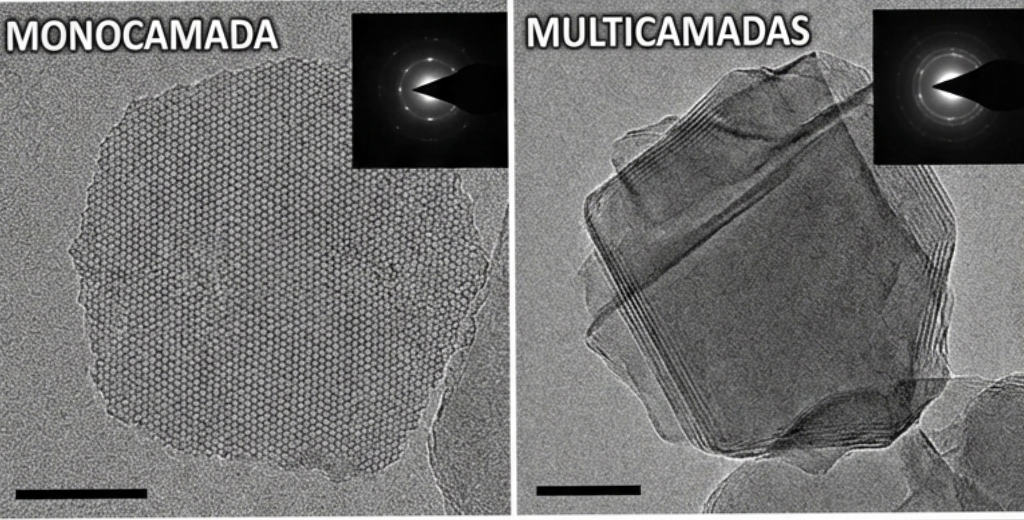
Comparison between single-layer graphene and multi-layer graphene obtained by electron microscopy. On the left, a single layer of carbon atoms is observed, arranged in a continuous hexagonal lattice (monolayer graphene). On the right, the overlapping of multiple layers is noticeable, characteristic of multilayer graphene, a structure more common in industrial applications due to its better balance between performance, processability, and economic viability.
Types of graphene and their main differences.
Although different types of Although it is often referred to as a single material, in practice there are different structural forms that exhibit distinct properties and varied behaviors when inserted into real industrial systems. These variations are mainly related to the number of layers in the material, the lateral size of the particles, the degree of structural defects, the specific surface area, and the chemical modifications present on the graphene surface.
Each of these characteristics directly influences fundamental properties such as electrical conductivity, thermal conductivity, mechanical reinforcement capacity, dispersion in different matrices, and structural stability in industrial environments. For this reason, when talking about graphene, it's important to understand that we are dealing with... a family of materials based on the same fundamental structure, but with characteristics that can vary significantly depending on the production method and processing applied.
Among the main types of graphene used in research and industrial applications, the following stand out: single-layer graphene, the multilayer graphene, the graphene oxide and the functionalized graphene. Each of these forms presents specific advantages and limitations that must be considered when selecting the most suitable material for a given technological application.
| Graphene Type | Structure | Main Advantages | Applications |
|---|
| Single-layer graphene | A single layer of carbon | Maximum electrical conductivity and electronic properties | Advanced electronics, sensors, scientific research |
| Multilayer Graphene | 3 to ~20 stacked layers | Better balance between performance and cost. | Polymers, composites, paints, construction |
| Graphene oxide | Layers with oxygenated groups | High dispersion in water and polar solvents. | Membranes, coatings, sensors |
| Functionalized Graphene | Chemically modified surface | Chemical compatibility and adjustable properties | Energy, sensors, biomaterials |
Single-layer graphene
Monolayer graphene is composed of only one atomic layer of carbon and represents the purest structural form of the material. In this configuration, graphene exhibits electronic properties close to the theoretical limit, as well as an extremely high surface area.
Due to these characteristics, this type of graphene is widely explored in academic research and high-tech applications, such as advanced electronics, optoelectronic devices, and high-sensitivity sensors.
However, production methods capable of generating high-quality monolayer graphene still present high costs and low scalability. For this reason, their use remains predominantly concentrated in research environments and highly specialized applications.
Multilayer graphene: the basis for industrial applications.
Multilayer graphene is formed by multiple stacked layers of graphene, generally ranging from three to twenty layers.
This structure offers a much more favorable balance between technical properties, ease of processing, and economic viability, which explains why most commercially available graphene belongs to this category.
In industrial applications, multilayer graphene has particularly stood out in:
- Reinforcement of polymers and composites;
- Functional paints and coatings;
- building materials;
- heat dissipation systems;
- Barriers against gases and moisture.
Due to its greater structural stability and improved processability, multilayer graphene has become the main driver of large-scale industrial adoption of graphene.
Graphene oxide
Graphene oxide is a derivative of graphene that features oxygenated functional groups distributed across its surface.
These chemical groups significantly alter the material's behavior, making it hydrophilic and facilitating its dispersion in water and polar solvents. This characteristic is particularly important for applications requiring processing in aqueous media.
Thanks to its ease of dispersion and the high chemical reactivity of its surface, graphene oxide has been widely explored in applications such as:
- Membranes for molecular separation;
- chemical sensors;
- polymer composites;
- functional coatings;
- materials for water purification.
Functionalized graphene
Functionalized graphene refers to materials in which the graphene surface is modified through the controlled introduction of chemical groups.
This modification allows adjusting properties such as compatibility with different matrices, chemical reactivity, and behavior in specific environments.
Graphene functionalization is particularly important in applications where the chemical interaction between graphene and the host material plays a key role.
- Among the areas in which functionalized graphene has been explored, the following stand out:
- chemical and biological sensors;
- energy storage devices;
- controlled drug delivery systems;
- advanced composites.
The importance of choosing the right graphene.
Selecting the right type of graphene is a crucial factor for the success of industrial applications based on nanomaterials.
The choice of material directly influences:
- the ease of processing;
- dispersion in the material matrix;
- the final performance of the application;
- the total cost of the technology solution;
- Industrial reproducibility.
Poorly specified graphene can compromise the performance of the final product, while the correct material selection allows for maximizing technical and economic gains.
Current challenges and evolution of the graphene market.
Despite recent advances, the widespread adoption of graphene still faces some technical challenges. These include achieving homogeneous dispersions, standardizing material characterization, and reducing costs in smaller volume applications.
However, as industrial graphene production advances and new manufacturing processes are developed, these obstacles are being progressively overcome.
This process has contributed to accelerating the incorporation of graphene in different industrial sectors, expanding the impact of this material on the development of advanced technologies.
Conclusion
Graphene has ceased to be merely a laboratory material and has come to occupy a strategic role in the development of advanced industrial technologies.
However, its success in real-world applications depends directly on understanding the different forms of the material and correctly specifying the most suitable type of graphene for each application.
At SuperGrafeno, we develop graphene solutions focused on real-world performance, scalability, and reliability, helping companies and researchers transform science into applied innovation.
 Enter contact Talk to our team and discover which type of graphene is ideal for your project.
Bibliography and Recommended Readings
The following references bring together Scientific reviews and widely cited articles that address the production, classification, processing, and industrial applications of graphene and its derivatives. These works serve as a conceptual and technical basis for understanding the different types of graphene and their uses on an industrial scale.
NOVOSELOV, KS; GEIM, AK; MOROZOV, SV; JIANG, D.; ZHANG, Y.; DUBONOS, SV; GRIGORIEVA, IV; FIRSOV, AA.
Electric field effect in atomically thin carbon films. Science, v. 306, no. 5696, p. 666–669, 2004.
DOI: 10.1126/science.1102896.
FERRARI, Andrea C.; BONACCORSO, Francesco; FAL'KO, Vladimir; NOVOSELOV, Konstantin S.; ROCHE, Stephan; BØGGILD, Peter; BORINI, Stefano; KOPPENS, Frank HL; PALERMO, Vincenzo; PUGNO, Nicola.
The rise of graphene-based materials for industrial applications. Nature Nanotechnology, v. 10, p. 973–981, 2015.
DOI: 10.1038/nnano.2015.242.
PALERMO, Vincenzo; YAP, Kin Lok; YOUNG, Robert J.
Production and processing of graphene and related materials. Nature Reviews Materials, v. 1, art. 16035, 2016.
DOI: 10.1038/natrevmats.2016.35.
DREYER, Daniel R.; PARK, Sungjin; BIELAWSKI, Christopher W.; RUOFF, Rodney S.
Graphene oxide: Fundamentals and applications. Chemical Society Reviews, v. 39, p. 228–240, 2010.
DOI: 10.1039/B917103G.