Graphene in Canada: Why the country is dominating advanced materials by 2025
A well-structured ecosystem positions Canada as a global leader in advanced materials, nanotechnology, and graphene.
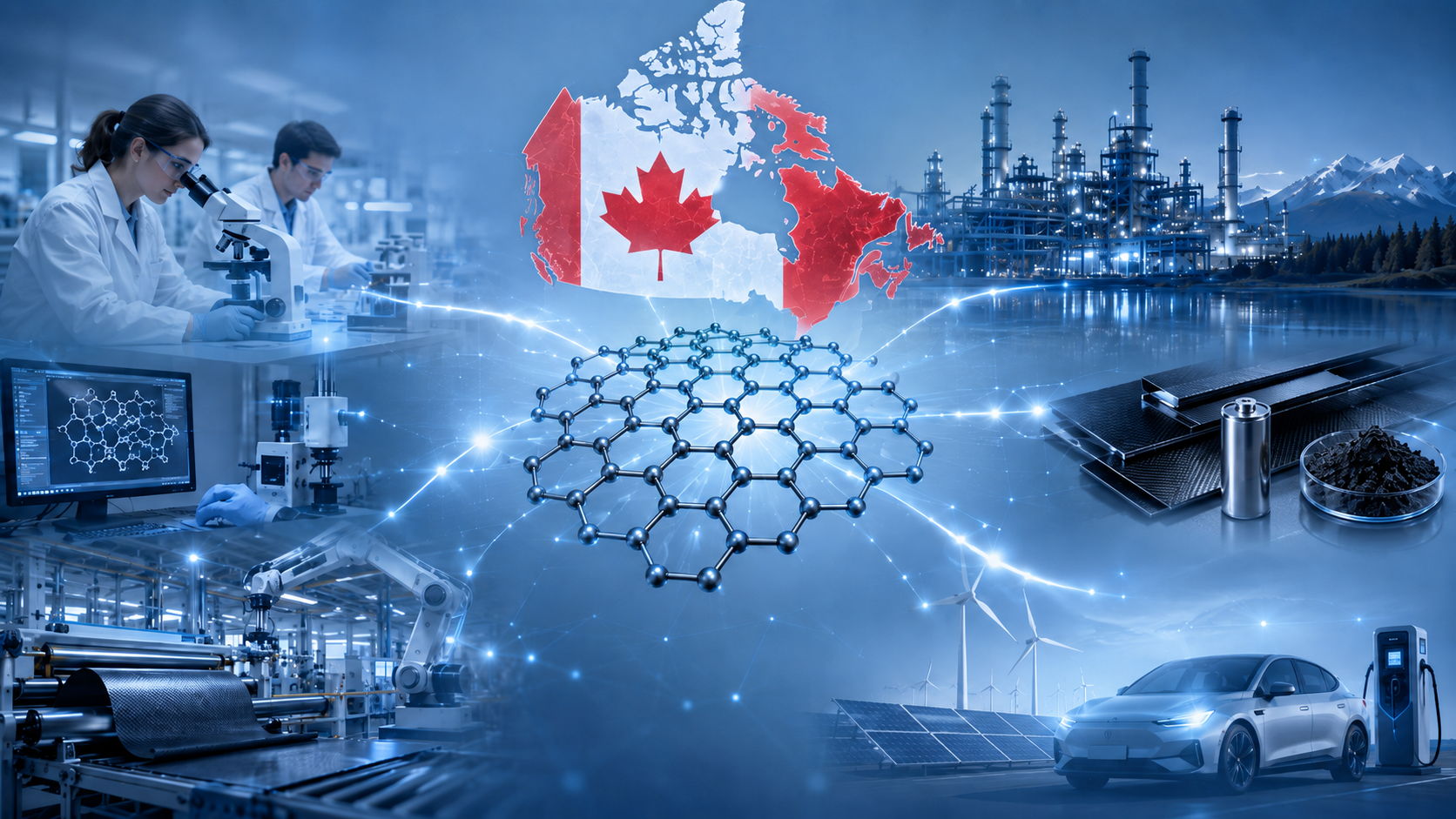
THE graphene Canada has established itself as one of the leading drivers of innovation in advanced materials and nanotechnology on the global stage. This progress reflects the construction of a highly structured ecosystem over the last few decades, in which science, engineering, and industry evolve in an integrated way. Unlike other countries that still face challenges in the transition between scientific research and industrial application, Canada has developed a coordinated model in which universities, research centers, government, and the productive sector work in alignment. This environment allows scientific discoveries to advance rapidly to technological validation stages and, subsequently, to commercial-scale application, significantly reducing the time between innovation and market.
This environment is supported by an extremely solid scientific foundation, comprised of internationally recognized institutions in areas such as materials science, chemical engineering, applied physics, and nanotechnology. However, the key difference lies not only in the generation of knowledge but also in the ability to transform that knowledge into viable industrial solutions. The country consistently invests in technological infrastructure, advanced laboratories, and collaborative programs between academia and the productive sector, creating a continuous flow of technological development. In this context, graphene in Canada stands out as one of the main drivers of innovation, connecting cutting-edge research to concrete industrial applications. This model favors not only incremental innovation but also the emergence of disruptive technologies with the potential for global impact.
Furthermore, Canada stands out for its strategic approach focused on industrialization from the early stages of development. Instead of concentrating efforts exclusively on technical performance at the laboratory scale, there is a clear concern with factors such as scalability, reproducibility, standardization, and economic viability. This focus is particularly relevant in the context of nanomaterials, such as graphene, whose industrial adoption depends directly on the ability to produce materials with consistent quality on a large scale. The advancement of graphene in Canada reflects this alignment between science, engineering, and the market, allowing the country not only to participate in global discussions on advanced technologies but also to take an active role in shaping the direction of the industry.
Integration between research and industry
The integration between scientific research and industrial application is one of the main pillars supporting Canada's advancement in advanced materials. Unlike fragmented models, where universities and companies operate in isolation, the country has built an ecosystem in which these actors are deeply connected. This connection not only accelerates technological development but also reduces the risk of innovations failing to reach the market. The result is an environment where research is born already oriented towards practical application.
This model is made possible by structured technology transfer mechanisms that encourage active collaboration between academia and industry. Partnership programs, innovation centers, and technology hubs allow companies to participate directly in scientific development. This creates a continuous flow of knowledge, in which real-world industrial problems guide research lines. As a result, innovation becomes more targeted, efficient, and economically relevant.
Another important point is the role of technology-based startups, which act as a bridge between research and the market. These companies are able to transform scientific discoveries into applicable solutions more quickly, testing business models and applications on a small scale. This dynamism helps accelerate technological maturation and reduce the time needed to validate new solutions.
In the field of graphene, this integration has been crucial for the advancement of concrete industrial applications. Technologies that were once restricted to the academic environment are now used in composites, coatings, and energy systems. This progress is only possible because there is a clear alignment between research, engineering, and market needs.
Companies like Black Swan Graphene, which already manufactures graphene in Canada and First Graphene These companies exemplify this scenario by operating directly at the interface between scientific development and large-scale production. Integrated into this ecosystem, they are able to accelerate the industrialization of technologies and expand their global presence, reinforcing Canada's role as a highly efficient environment for transforming knowledge into economic value.
Focus on scalability and industrial application.
One of the major distinguishing features of the Canadian model is its focus on scalability from the early stages of technological development. Instead of focusing exclusively on laboratory performance, the country adopts an approach that considers industrial viability from the outset. This significantly reduces the risk of technologies that only work on a small scale.
This mindset involves factors such as reproducibility, process standardization, and supply stability. These elements are incorporated in the early stages of development, ensuring that the technology has real application potential. As a result, the transition process from laboratory to industrial becomes more efficient.
In the case of nanomaterials, this approach is even more critical. Graphene, for example, presents challenges related to dispersion, structural consistency, and quality control. Canada stands out for addressing these variables in an integrated way, connecting advanced characterization with production engineering.
This ability to align science and industry allows us to reduce the gap between innovation and the market. The result is an environment where technologies are not only developed, but effectively implemented at scale, generating economic and industrial impact.
Regulatory and strategic incentives
The Canadian regulatory environment plays a key role in establishing the country as a global leader in advanced materials. Predictability, transparency, and institutional stability create a favorable environment for innovation investments, especially in medium- and long-term projects. This level of legal certainty reduces risks and allows companies to develop technologies with greater confidence, knowing they will have consistent regulatory support throughout the process.
Furthermore, structured public policies directly encourage applied research and technology transfer. Funding programs, tax incentives, and innovation support mechanisms allow companies and research centers to share costs and accelerate technological development. This model not only stimulates innovation but also creates a competitive and dynamic environment in which new technologies can evolve more rapidly.
Another relevant factor is the strong openness to international cooperation, which positions Canada as a global innovation hub. This connectivity broadens access to knowledge, markets, and strategic partnerships, strengthening the local ecosystem and consolidating the country as one of the main points of convergence in the development of advanced technologies.
Nanotechnology and graphene in the global scenario
Nanotechnology has established itself as one of the main frontiers of materials engineering, driving significant advances in various industrial sectors. Within this context, graphene stands out as a strategic material due to its unique combination of physical and structural properties. This versatility expands its potential for application in different areas, especially in the development of graphene in Canada, where there is strong integration between research and industry.
Among the main benefits associated with graphene are increased mechanical strength, improved thermal and electrical conductivity, and reduced permeability. These characteristics allow its incorporation into systems that require high performance, contributing to the evolution of industrial products and processes. The advancement of graphene in Canada demonstrates how these properties are being efficiently exploited in real-world applications.
In recent years, the focus has shifted from purely fundamental research to include the practical application of the material. This requires integration between scientific knowledge, materials engineering, and production processes, ensuring that graphene is used efficiently and consistently. In this context, graphene in Canada stands out for its ability to transform scientific knowledge into viable industrial solutions.
In this scenario, Canada positions itself as one of the global leaders, combining advanced research with industrialization capacity. This integration strengthens the country's role in consolidating graphene as an essential material for the future of industry, with graphene in Canada being one of the prime examples of this evolution.
Strategic vision in the global graphene market
The global graphene market is evolving rapidly, with growing demand for solutions that combine technical performance, scalability, and economic viability. As applications mature, the need for consistent materials and reliable production processes increases. In this scenario, graphene in Canada stands out as a global benchmark in consolidating these solutions on an industrial scale.
Integrating into established technological ecosystems becomes an important strategic differentiator. Participation in environments like the Canadian one allows not only for keeping up with trends but also for accelerating the development of industrial applications. The advancement of graphene in Canada demonstrates how this integration can reduce the time between research and commercial application.
This connection also facilitates the establishment of strategic partnerships, which are fundamental to the sector's evolution. Collaboration between different actors allows for the integration of scientific knowledge with market needs, resulting in more robust solutions. This model is widely observed in the development of graphene in Canada, where synergy between academia and industry drives innovation.
In this context, SuperGrafeno positions itself as a link between science, industry, and the market, connecting technical development, international partnerships, and industrial application in Brazil, aligning itself with global trends driven by graphene in Canada.
Strategic connections and a vision for the future.
Canada's strengthening as a global hub for advanced materials reflects a model based on integration, collaboration, and a long-term vision. This model demonstrates that innovation depends not only on generating knowledge but also on the ability to transform it into applicable and economically viable solutions. In this context, graphene in Canada is consolidating itself as one of the main examples of this integrated approach, highlighting the country on the global stage.
In the case of graphene, this convergence between research, engineering, and industry is essential to transform technological potential into real impact. The large-scale adoption of the material depends directly on this capacity for integration, which defines the pace of evolution of industrial applications. The advancement of graphene in Canada demonstrates how this connection between different sectors accelerates innovation and industrialization.
Companies wishing to position themselves in this scenario need to actively participate in these ecosystems, establishing strategic connections and investing in technological development. This movement not only expands opportunities but also consolidates a relevant position in the global market for advanced technologies, especially when aligned with trends driven by graphene in Canada.
If your organization is looking to expand operations, develop projects in Canada, or establish strategic partnerships within this ecosystem, SuperGrafeno can share its practical experience and assess opportunities for structured technical cooperation.
 Enter contact Contact our team to initiate a strategic dialogue.